Dental clinics run on precision, timing, and trust — and in 2026, artificial intelligence is helping dentists deliver all three. From AI that reads X-rays with specialist-level accuracy to assistants that handle appointment reminders and insurance paperwork, the right tools can cut chairside time, reduce missed diagnoses, and keep schedules full. This guide rounds up the 7 best AI tools for dentists and dental clinics in 2026, so you can modernise your practice without the trial-and-error.
Why Dental Practices Are Turning to AI
Dentistry generates enormous amounts of data — radiographs, intraoral scans, treatment plans, patient messages — and AI thrives on exactly this kind of structured information. Here is why forward-thinking clinics are adopting it:
- More accurate diagnoses: AI models trained on millions of radiographs can flag early decay, bone loss, and periapical lesions that are easy to miss on a busy day.
- Faster workflows: Voice-driven charting and automated notes free dentists and hygienists from hours of after-hours documentation.
- Fuller schedules: Smart recall and reminder systems cut no-shows and bring lapsed patients back automatically.
- Better case acceptance: Visual, AI-annotated X-rays help patients actually see what is wrong, which builds trust and lifts treatment acceptance rates.
Before diving in, a quick note on pricing: most dental AI tools charge per location or per user, with free tiers or trials available on some plans. Pricing changes frequently, so check each vendor’s current pricing before making a decision.
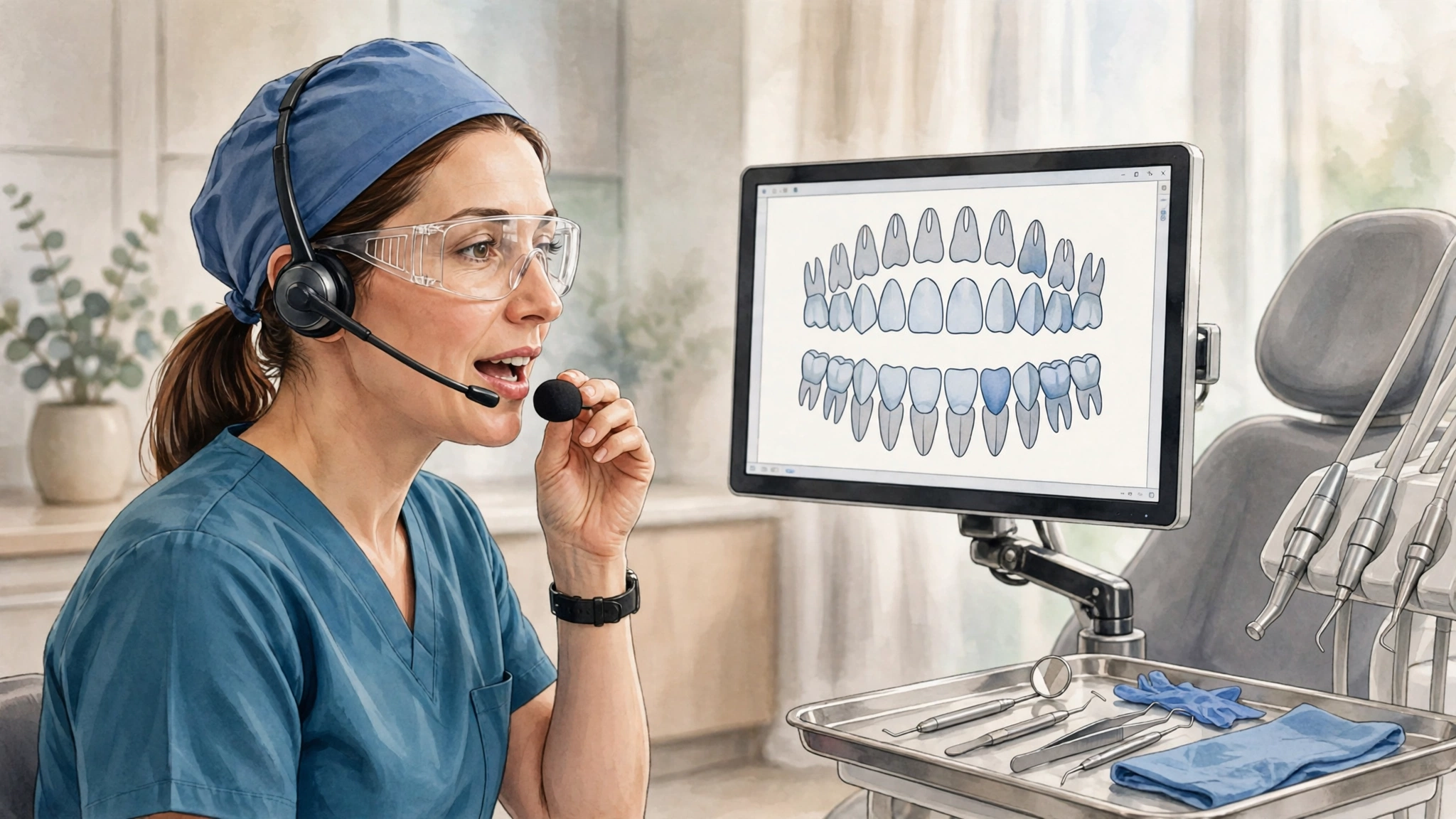
1. Overjet — Best AI for Dental Radiograph Analysis
Overjet is one of the most widely adopted dental AI platforms, FDA-cleared to analyse dental X-rays for decay, calculus, bone levels, and periapical lesions. It overlays colour-coded annotations directly on radiographs, giving the dentist a second, tireless pair of eyes.
Clinics use Overjet for:
- Detecting early cavities and bone loss with consistent accuracy
- Quantifying disease severity with millimetre-level measurements
- Standardising diagnoses across multiple providers and locations
- Improving payer documentation with objective, visual evidence
Overjet also integrates with major practice management systems, so annotated images flow into the patient chart without duplicate data entry. Multi-location groups particularly value its ability to benchmark clinical consistency across offices.
2. VideaHealth — Best for AI-Powered Clinical Insights
VideaHealth is another FDA-cleared dental AI platform focused on radiograph analysis, with strengths in caries detection, bone loss measurement, and restorations mapping. Its differentiator is the breadth of its analytics: beyond per-image findings, VideaHealth surfaces population-level insights across your entire patient base.
That means a practice can spot patterns — such as untreated caries rates by provider or recall cohort — and act on them systematically rather than tooth by tooth. Like other leading tools, it plugs into existing imaging and practice-management software, so adoption does not mean ripping out your current stack.
3. Pearl Second Opinion — Best Chairside AI Diagnostics
Pearl’s Second Opinion runs in real time while the patient is still in the chair. It analyses bitewing, periapical, and panoramic radiographs and instantly highlights conditions such as caries, periapical radiolucencies, calculus, crowns, fillings, and root canals.
The chairside immediacy matters: instead of scheduling a follow-up to discuss findings, the dentist can walk the patient through AI-annotated images in the same visit. Practices report that this visual, same-day approach meaningfully improves treatment plan acceptance — patients trust what they can see.
4. Bola AI — Best for Voice-Driven Charting
Documentation is one of dentistry’s biggest time sinks. Bola AI uses voice recognition tuned specifically for dental terminology to capture perio charting and clinical notes hands-free. The dentist or hygienist simply speaks — “upper right, pocket depths 3-2-3” — and Bola AI enters the data directly into the practice management software.
- Purpose-built dental vocabulary (periodontal charting, restorative notes)
- Hands-free workflow that keeps infection-control protocols intact
- Faster charting sessions that leave more time for patient care
If your team stays late finishing notes, this category of tool often delivers the quickest quality-of-life improvement of any AI investment.
5. Weave — Best for Patient Communication and Reviews
Weave is an all-in-one communication platform popular with dental clinics: two-way texting, automated appointment reminders, missed-call texts, online scheduling, and review requests all live in one dashboard. Its AI-powered features include smart responses and call analytics that show which patient interactions convert into booked appointments.
The business impact is direct: automated reminders and recall messages reduce no-shows, and well-timed review requests grow your Google rating — the single biggest driver of new-patient acquisition for local clinics. For a fuller look at AI scheduling across industries, see our guide to the best AI calendar and scheduling assistants.
6. Dental Intelligence — Best for Practice Analytics
You cannot improve what you do not measure. Dental Intelligence pulls data from your practice management system and turns it into clear dashboards: production by provider, hygiene reappointment rates, unscheduled treatment, case acceptance, and morning huddle metrics.
Its AI layer prioritises the opportunities — a list of patients with diagnosed-but-unscheduled treatment, hygiene patients due for recall, and providers falling behind targets — so the front office knows exactly where to focus each day. Practices that previously relied on gut feel and end-of-month reports find this real-time visibility transformative.
7. RevenueWell — Best for Automated Recall and Marketing
RevenueWell automates the patient-engagement campaigns that keep a schedule full: recall reminders, birthday messages, reactivations for lapsed patients, and treatment-plan follow-ups. Its analytics track which campaigns actually bring patients back, so you can double down on what works.
For clinics losing revenue to an empty hygiene column or patients who never return after a consult, RevenueWell-style automation typically pays for itself many times over. Healthcare-focused AI is also transforming adjacent professions — see our roundup of the best AI tools for therapists and counselors for a parallel example.
Comparison Table: Dental AI Tools at a Glance
| Tool | Primary Use | Best For | Pricing Note |
|---|---|---|---|
| Overjet | Radiograph analysis (caries, bone loss) | Diagnostic accuracy & multi-location consistency | Paid plans available — check current pricing |
| VideaHealth | Radiograph analysis + clinical insights | Practices wanting data-driven treatment tracking | Paid plans available — check current pricing |
| Pearl Second Opinion | Real-time chairside diagnostics | Same-visit case presentation & acceptance | Paid plans available — check current pricing |
| Bola AI | Voice-driven perio charting & notes | Cutting documentation time | Paid plans available — check current pricing |
| Weave | Patient texting, reminders, reviews | Reducing no-shows & growing reviews | Paid plans available — check current pricing |
| Dental Intelligence | Practice analytics & KPIs | Data-driven management decisions | Paid plans available — check current pricing |
| RevenueWell | Automated recall & marketing campaigns | Filling schedules & reactivating patients | Paid plans available — check current pricing |
How to Choose the Right AI Tools for Your Clinic
Follow this simple five-step process to avoid buying software you will not use:
- Identify your biggest bottleneck. Missed diagnoses? Then start with radiograph AI. Late-night charting? Try voice dictation first. Empty chairs? Prioritise recall automation.
- Check integrations. Shortlist only tools that connect with your existing practice management and imaging software — re-entering data kills adoption.
- Pilot with one location. Run a 30–60 day trial with one provider or office, measure the result (case acceptance, no-show rate, charting time), then roll out.
- Train the whole team. AI tools fail when only the dentist knows how they work. Include hygienists and front-desk staff in onboarding.
- Verify compliance. Confirm each vendor’s HIPAA compliance and data-handling policies before any patient data touches their servers.
FAQ
Is AI in dentistry safe and reliable?
Leading dental AI tools are FDA-cleared medical devices validated against large annotated datasets. They are designed as decision support — the dentist always makes the final call — and studies show they catch early disease that busy clinicians can miss.
Will AI replace dentists?
No. AI excels at pattern recognition and paperwork, but treatment planning, surgical skill, and patient relationships remain firmly human. Think of dental AI as an expert assistant that never gets tired, not as a replacement.
How much do AI dental tools cost?
Pricing varies widely by vendor and practice size, typically charged per location or per provider per month, with free trials available on many plans. Because pricing changes often, always check each vendor’s current pricing and ask for a quote before committing.
Do these tools work with my existing practice management software?
Most leading tools integrate with the major systems (Dentrix, Eaglesoft, Open Dental, and others) and standard imaging software. Always confirm compatibility with your specific setup during a demo.
What is the easiest AI tool for a small clinic to start with?
Start with your pain point: voice-driven charting (like Bola AI) if documentation eats your evenings, or automated reminders (like Weave or RevenueWell) if no-shows are the issue. Both are quick to deploy and show results within weeks.
Final Thoughts
AI is no longer experimental in dentistry — it is a competitive advantage. Clinics that adopt AI-assisted diagnostics, smarter scheduling, and automated patient communication are seeing higher case acceptance, fewer no-shows, and happier teams. Start with one tool that solves your biggest bottleneck, measure the impact, and expand from there. Your patients — and your schedule — will notice the difference.
Pingback: 7 Best AI Tools for Nurses to Try in 2026
Pingback: 7 Best AI Tools for Doctors to Try in 2026